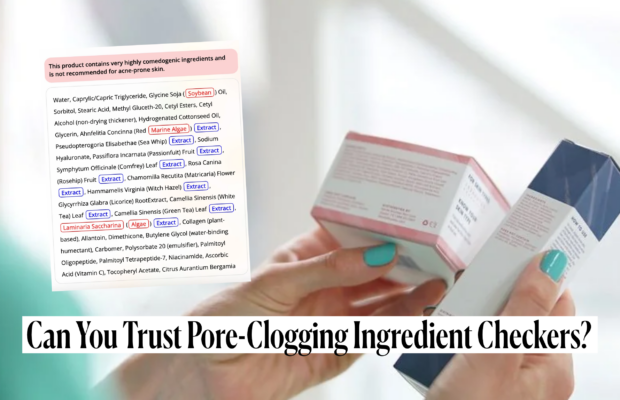
If you’re acne-prone, chances are you’ve used an ingredient checker at some point. You find a product you’re interested in, paste the ingredient list into an app, and wait for the results. Within seconds, you’re told whether a product contains ingredients that could potentially clog your pores.
Seems helpful… But what happens when an ingredient checker flags your favorite moisturizer and warns that it’s not recommended for acne-prone skin? Should you immediately stop using it? The answer is, no, not necessarily.
Ingredient checkers have been around for decades, most commonly ranking individual ingredients based on their potential to clog pores. And while these tools might seem like a simple way to make better skincare decisions, there’s a lot they’re not telling you.
I recently co-hosted a free course with award-winning cosmetic chemist Valerie George (@cosmetic_chemist), and I wanted to tap into her expertise on ingredient checkers, how they work, and whether a flagged ingredient really means a product will cause breakouts. This topic was just one of the modules we covered, so I highly recommend watching the full course to learn how ingredients and formulas really work.
The Problem With Ingredient Checkers
One of the biggest frustrations for formulators is how ingredient checkers can turn a complicated topic into a very black-and-white answer.
From a cosmetic chemist’s perspective, Valerie explained that these tools cannot reliably tell you whether a finished product is suitable for acne-prone skin, whether it’s truly “acne-safe,” or whether it’s going to actually cause a breakout.
From my perspective as an esthetician who has treated 25,000 faces, clients are looking for answers for the cause of their breakouts, and I can understand why the checkers are appealing. But, it’s just not how it works. Acne is quite complicated and the cause is rarely from products.
So let’s talk about where their ratings come from. Most ingredient checkers rely on ratings based on older testing or previously available data. And historically, ingredients were often tested at very high concentrations, sometimes even at 100%. But that’s not typically how those ingredients are used in your skincare products.
Why Concentration and Formulation Matter
Just because an ingredient has a highly comedogenic rating doesn’t mean it will have the same effect in every product containing it. Concentration matters, and so does everything else in the formula.
Valerie also pointed out that an ingredient might not be ideal for acne-prone skin when used at a 2% concentration on its own. But when combined with other ingredients, its behavior can change entirely. The finished formulation may be perfectly suitable for someone with breakout-prone skin. This is why looking at individual ingredients without considering the complete formula can be misleading.
How Should You Evaluate Skincare Products If You’re Acne Prone?
If you tend to break out easily, it makes sense to be picky about what you put on your skin. But relying exclusively on ingredient checkers may actually limit your skincare options without giving you the full information you need.
Here’s a quick recap and recommendation:
- Consider the complete formulation. Concentrations and how ingredients work together can give you a better idea of how a product behaves.
- Pay attention to how your skin responds. Your own experience is way more useful than a generalized ingredient rating. Always do a patch test and consult with an esthetician.
- Don’t automatically toss a product because of one flagged ingredient. A high rating doesn’t guarantee that the product will cause breakouts.
- Always choose products for your skin type and its needs. I believe there are 9 types of skin and you can take this Skin Type Quiz to find out yours and get my expert advice and product recommendations.
So the next time an ingredient checker gives your favorite moisturizer a not-so-glowing review, take the result with a grain of salt. Your skin deserves more personalized care than an app can provide.
Want to learn more about the science behind ingredients? Watch our free course Understanding Skincare Ingredients with a Cosmetic Chemist & Esthetician, now available at Renée Rouleau Education. And while you’re at it, you’ll enjoy learning how to fade hyperpigmentation.

Celebrity Esthetician & Skincare Expert
As an esthetician trained in cosmetic chemistry, Renée Rouleau has spent 35 years researching skin, educating her audience, and building an award-winning line of products. Her hands-on experience as an esthetician and trusted skin care expert has created a real-world solution — products that are formulated for nine different types of skin so your face will get exactly what it needs to look and feel its best. Trusted by celebrities, editors, bloggers, and skincare obsessives around the globe, her vast real-world knowledge and constant research are why Marie Claire calls her “the most passionate skin practitioner we know.”