If you know me at all, you know that one of my favorite questions is: What problem are we actually trying to solve? It’s the first thing I ask when I’m formulating a product, and it’s the same question I ask myself anytime I’m considering a treatment for my own skin.
I’m a pretty intentional person. I don’t do things just because they’re trending, and I definitely don’t do them without understanding the why.
At 56, I’m not someone who’s gone down the road of invasive skin procedures. Yes, I do Botox. I’ve had a bit of filler. But when it comes to professional facial treatments, this Halo treatment was the most invasive thing I’ve ever done. Prior to this, the only other laser I’d tried was Moxi about a year ago, which is very mild and, in my opinion, a great entry point into laser treatments.
That said, I’m at a point in life where I felt ready to dial things up a bit.
Why I Decided to Do Halo at Age 56
Like most people in their 50s and beyond, I’m starting to notice changes in my skin texture. Collagen naturally declines. That’s normal. And to be clear, I’m not unhappy with my skin. I actually know I’m ahead of the curve thanks to nearly four decades of consistent skincare (I’m a skin type 6 these days, find your skin type), minimal sun exposure (growing up in the midwest, there is very little opportunity to be in a bathing suit with the summers being so short!), and a deep understanding of how skin functions.
Still, I wanted to see if I could improve some crepiness and support collagen in a meaningful way. Plus, our customers ask me a lot about lasers and I don’t have much personal experience so I’m taking one for the team.
But before I say yes to anything involving my skin, I insist on a thorough consultation. And I encourage everyone to do the same. You HAVE to know what you’re getting yourself into. No surprises.
The Consultation: Setting Realistic Expectations
One of my biggest pet peeves in this industry is when recovery time is downplayed. There is nothing worse than being told you’ll be “fine in a few days,” only to find yourself still hiding at home when life needs to go on. I can’t tell you how many times I’ve heard this from people, and it’s super annoying.
During my consultation, I asked very direct questions:
- How long is the recovery, really?
- What’s the worst-case scenario for recovery?
- Am I actually going to see a difference when I look in the mirror? Where and when?
I was told I should plan on about seven days before I’d feel comfortable going back out into the world, and that ended up being fairly accurate.
I also asked my favorite question: What problem is this solving for me? Not what it could do, and not what it does for someone else. What would it realistically do for me and my skin type?
The nurse explained that Halo could provide some superficial smoothing, especially in areas where my skin tends to look crepey, like around the upper lip (which, to be fair, is notoriously difficult) and in the nasolabial fold area (smile lines). She was very clear that the collagen-building occurs within 90 days after treatment. It’s also not strongest laser on the market and doesn’t work extremely deep, but it offers a balance of results with manageable downtime.
She also said something that made me smile: “You have Renée Rouleau skin, so you’ll heal well.” That’s what nearly 40 years of taking care of skin will do. Okay, let’s do this.
Why I Chose Halo Specifically
Halo is a hybrid fractional laser, meaning it uses two wavelengths at once. One resurfaces the surface of the skin, while the other heats deeper layers to stimulate collagen. It creates thousands of tiny, controlled treatment zones while leaving surrounding skin intact, which helps improve texture, tone, pores, and fine lines with faster healing. Over the weeks that follow, old damaged skin sheds and new collagen forms, leading to smoother, firmer, more even-looking skin.
I love that Halo takes an inside-out approach, and this is what appealed to me.
But here’s what I know about collagen. As we age, the skin gets a little lazy. So I like to think of treatments like this as giving the skin a shock to the system. A signal that we’re not sending it off into retirement just yet. (Collagen, please don’t fail me now!)
I was told not to expect immediate collagen changes, but that over the course of 90 days, some people notice improvements in skin-firming and a smoother texture. I won’t be obsessively photographing my face to track every change and I’m simply going to trust that it’s contributing to the greater good. It’s kind of like eating broccoli. I eat it because it’s good for me, not because I expect to wake up feeling or looking any different the next morning.
Treatment Day: What It Actually Felt Like
On treatment day, numbing cream was applied for about an hour. I’ll be honest, having a numbed face is a little freaky. You start to talk and your mouth feels all weird but I got used to it.
Even with numbing, I’d rate the actual zapping of the Halo laser a discomfort around a 6 out of 10. It’s manageable, but it’s not nothing, so I think it’s important to be mentally prepared for that. She said she could give me laughing gas, but I’m a tough cookie, so I didn’t do that.
Immediately after, my skin was extremely red and very hot. It honestly felt like I’d poured jalapeño juice all over my face. They applied a cold sheet mask, which helped a lot, and I even drove home wearing it.
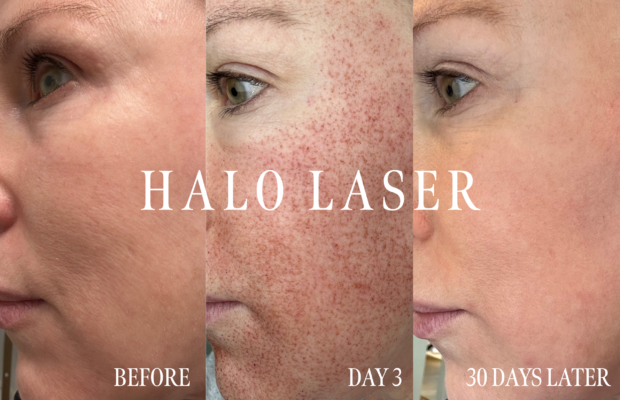
Within about an hour, the intense heat subsided, though my skin still felt warm. Swelling started soon after, which was expected. What surprised me most was seeing the tiny channels (essentially holes) all over my skin, with a bit of pinpoint bleeding. It’s wild to see, but also fascinating. I mean…the things we do for beauty!
We had chosen to do a stronger setting, knowing I was fully prepared to be hibernating for a week. When I commit, I commit but this means camera-off for zoom meetings!
That night, I slept with my head elevated to help with swelling. Sleep wasn’t great. My face was still hot and very stimulated, but that was expected.
Day-by-Day Recovery
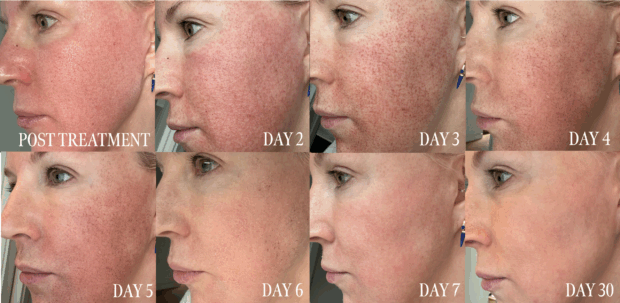
Day 2:
Peak redness and swelling. My face was beet red and very puffy. My skin felt tight and dry. I was given a post procedure serum from Revision, but it stung so badly. I know skin well enough to know that when your barrier is compromised, you don’t add fire to fire. I stopped immediately and switched to my Rest Day Masque, which felt incredibly soothing and didn’t sting at all.
Day 3:
Still red and swollen, but now drier. Swelling began shifting downward as it was desperately trying to find a place to go resulting in pooling under my chin, which looked wild but is normal as fluid tries to drain out.
Day 4:
The skin feels like sandpaper. This is when things started turning a corner. My skin started taking on that bronzed look as the microscopic dots (AKA “mends”) became more visible.
Day 5–6:
Okay, the worst is over. Phew. Less redness, but still dry and puffy. The skin still feels like sandpaper, but the mends begin to flake off naturally. I’m being very good at not messing with them because you want to let Mother Nature run its course and don’t get those off before they are ready because they are attached to live skin cells.
Day 7:
Most of the mends are gone and my skin doesn’t feel as rough to the touch as it did and it is incredibly dry. As for the swelling, I went for a gentle lymphatic drainage facial massage to push the fluids away from my face and especially my neck where it had pooled up a lot and this helped. My face is still pretty pink.
Day 8-15:
The puffiness is winding down but my skin is still a bit red, especially when I wash my face, and it feels really dry and feels rough to the touch. It’s crazy because I’ve never had dry skin (I’m a skin type 6) and so this was a reminder that this treatment was aggressive. My skin barrier was definitely damaged, but that was the whole point.
I’m now starting to get some breakouts which I haven’t had in years. I was told that this could occur, and it makes sense because when you’re overly dry and you still have oil glands underneath the skin (which I do), your skin tries to push out oil to compensate for all the dryness, and they get trapped under the skin and voila, breakouts appear.
Day 16-20:
The redness is subsiding which is a telltale sign that my skin barrier is correcting and the dryness is finally getting much better.
Day 21:
My skin feels back to normal. It’s baby soft again, and I’m no longer feeling dry.
Post-Procedure Skincare: What I Actually Used
I know this is the part everyone wants to know, so let’s talk about exactly what I used on my skin after Halo and when I used it. Keep in mind, post-laser skin is compromised skin, so everything I did was about calming, protecting, and supporting healing. Nothing aggressive. Nothing trendy.
My Post-Halo Routine:
Morning and night
I cleansed with Moisture Protecting Cleanser morning and night. This was non-negotiable. After laser, your skin barrier is fragile and you want a cleanser that removes debris without stripping or irritating the skin.
Treatment step
After cleansing, I used Vitamin C&E Treatment. I want to mention that it is advised to not use vitamin C after laser treatments, but read why I broke the rule. This might surprise some people, but this formula is very barrier-friendly and doesn’t cause the infamous “vitamin C acid burn” like many can. But of all the times you need antioxidant support, it’s when your skin is inflamed.
Soothing and recovery
Next came Rest Day Masque. I absolutely lived in this. I applied it generously and often, especially in the first week. It was incredibly soothing and helped take down that tight, dry, uncomfortable feeling. I continued to use it most nights for the first month to correct my skin barrier.
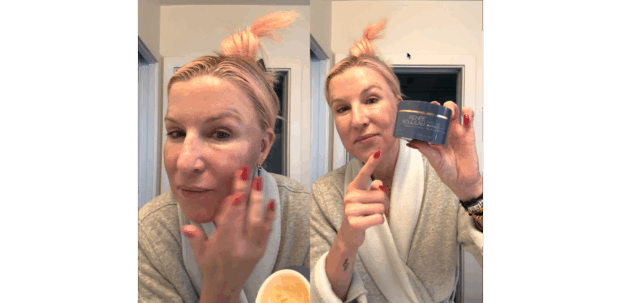
Cooling and swelling support
Starting on day four, I added an ice roller every three hours. I used the Skinny Confidential ice roller. This helped tremendously with swelling and made my skin feel calmer overall. I wish I had done this sooner.
Once the Mends Were Gone
I mentioned these earlier, but mends are those tiny little dots you’ll see after treatment where the laser worked. They can look dark and feel rough or sandpapery at first, then naturally flake off as fresh, new skin comes through.
Once my mends were completely gone (which for me was around day nine), my skin felt very rough. This is where things get nuanced.
I gently introduced Triple Berry Smoothing Scrub. I know most providers would cringe at the thought of a scrub post-laser, but here’s what they don’t know: Triple Berry uses perfectly round biodegradable beads, so there is no scratching or tearing of the skin. It is not harsh at all.
When skin is rough like this, physical exfoliation is sometimes exactly what it needs. This is about physically removing dead, dry cell buildup that is ready to come off. I used it very gently once a day from day nine through day fifteen, and it made a big difference in smoothing the texture.
Sun Exposure and Makeup
I have a lot of windows in my home, which means a lot of ambient UV exposure. Early on, I simply applied foundation on top of Rest Day Masque for a bit of added protection.
I did not start wearing sunscreen until day seven. At that point, I introduced Weightless Protection SPF 30. Before that, my skin just was not ready.
When I started getting some breakouts, I used Rapid Response Detox Masque after cleansing this was really soothing on my skin, but also helps to stop my breakouts from forming. It was a life saver.
Results and Final Thoughts
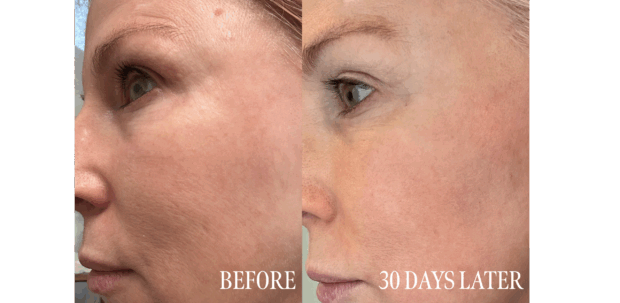
By day 30, my skin looks incredibly glowy and reflective. I do notice a subtle softening of crepiness, especially around the nasolabial folds. The lines above my lip, which are very deep, are slightly softened I think. But I’m never expecting miracles there.
I’ll continue watching how my skin changes over the next few months as collagen production progresses.
Was it worth it? Yes. I believe so. You’ve got to shake things up every now and again.
Would I do it again? Absolutely. I will get it done in another nine months as suggested by my provider.
Is it a hassle to hibernate in my house for a week? Absolutely, yes. But I know what to expect now.
A couple final notes:
- On Day 2, I weighed four pounds more than usual, despite no dietary changes. I guess it was from swelling and puffiness. Who knows?
- I was told that Halo is not recommended for those with melasma (but guess what, HyperFix Fading Toner is!), so Halo is not for everyone. A thorough consultation is absolutely essential.
- I don’t believe this is necessary for people in their 20s. Collagen hasn’t slowed yet. In my opinion, late-30s and beyond is where this starts to make sense. But I’m sure others have different opinions about this.
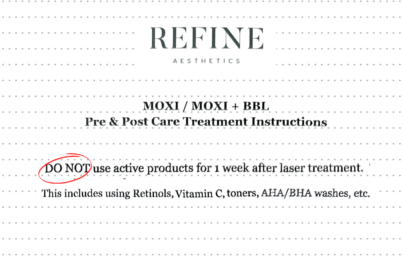
For anyone curious, I had my Halo treatment done at Refine Aesthetics in Austin, a PRO Partner of ours that also carries my skincare line. If you’re considering a laser, working with a provider who understands the power of touch, not just devices, makes all the difference.
Overall, I’m glad I did it. And I feel confident recommending it, as long as expectations are realistic.
Celebrity Esthetician & Skincare Expert
As an esthetician trained in cosmetic chemistry, Renée Rouleau has spent 35 years researching skin, educating her audience, and building an award-winning line of products. Her hands-on experience as an esthetician and trusted skin care expert has created a real-world solution — products that are formulated for nine different types of skin so your face will get exactly what it needs to look and feel its best. Trusted by celebrities, editors, bloggers, and skincare obsessives around the globe, her vast real-world knowledge and constant research are why Marie Claire calls her “the most passionate skin practitioner we know.”