Why Estheticians Love This Ingredient For Hyperpigmentation
Hyperpigmentation is one of the most frustrating skin concerns I see in my treatment room. It’s stubborn, unpredictable, and often made worse by (well-intentioned) skincare mistakes.
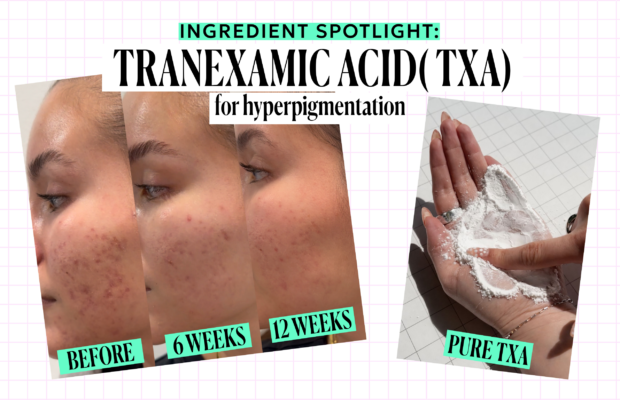
When it comes to treating hyperpigmentation, no single topical ingredient does it all. You need many ingredients in your hyperpigmentation toolkit, and I’m especially excited about new advancements such as tranexamic acid (also known as TXA).
What makes it special isn’t just that it helps fade dark spots. It’s how it works. To understand why estheticians are excited about tranexamic acid, you first need to understand how pigmentation actually forms on the skin.
Hyperpigmentation 101
Hyperpigmentation is an overproduction of melanin that shows up as brown, red, purple, or grayish spots and patches on the skin. While it may look similar on the surface, pigmentation doesn’t all form the same way underneath.
There are two main triggers:
1. Inflammation-based pigmentation
When the skin experiences inflammation, such as breakouts, over-exfoliation, bug bites, eczema, psoriasis, or a compromised skin barrier, a chemical called arachidonic acid is produced. This leads to post-inflammatory hyperpigmentation, often referred to as PIH.
This type of discoloration usually starts red, fades to purple, and eventually settles into a brownish tone.
2. UV-induced pigmentation
UV exposure activates melanogenesis, a process driven by an enzyme called tyrosinase, which tells the skin to produce more pigment. This results in brown or grayish spots, including melasma, freckles, and sun-induced discoloration.
And yes, UV exposure includes sunlight coming through windows.
Here’s where things get interesting. Most brightening ingredients only work on one of these pathways. That’s a big limitation.
Why Tranexamic Acid Is Different
Tranexamic acid works by blocking the plasminogen pathway, which sits at the top of both pigmentation triggers.
By interrupting this pathway, tranexamic acid helps prevent:
- The formation of arachidonic acid (inflammation-based pigmentation)
- The activation of tyrosinase (UV-induced pigmentation)
In other words, it helps put the fire out before pigment is fully formed.
This dual-pathway approach is what makes tranexamic acid so effective for all types of hyperpigmentation, not just one specific kind.
Where You’ll Find Tranexamic Acid in Your Action Plan
One of my favorite ways to deliver tranexamic acid to the skin is through a toner. After cleansing, skin is bare and slightly damp, which is when penetration is most effective. Water acts as a carrier, helping ingredients absorb more efficiently.
This is exactly why I chose tranexamic acid for HyperFix Fading Toner. It was formulated to target stubborn discoloration at the source while respecting the skin barrier. By combining tranexamic acid with other skin-supporting ingredients, HyperFix helps calm inflammation-driven pigmentation while also addressing UV-induced discoloration, all without irritation.
Because it’s gentle and non-exfoliating, HyperFix Fading Toner can be used daily and layered easily with other brightening ingredients like niacinamide, making it an ideal option for skin that’s reactive, sensitive, or prone to post-inflammatory marks. Despite its chemical structure being an acid, it does not have a low pH and therefore is not considered an exfoliating acid.
Real Results You Can Feel
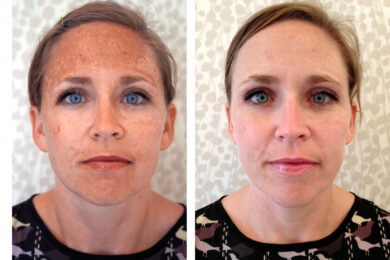
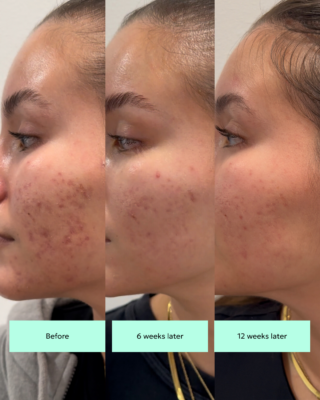
Amanda (Skin Type 1) used HyperFix Fading Toner consistently morning and night for 12 weeks, and the results speak for themselves. Her skin looks smoother, brighter, and more even-toned. Stunning before, stunning after.
How Tranexamic Acid Compares to Common Brightening Ingredients
There’s no shortage of pigmentation treatments on the market, but not all are created equal.
- Hydroquinone is effective but highly regulated due to toxicity concerns and is banned in some countries. If it’s avoidable, I prefer not to go there.
- Kojic acid and arbutin can be unstable and irritating.
- Azelaic acid is primarily for rosacea and works very slowly for pigmentation.
- Alpha Hydroxy Acids are very effective, however they can increase sun sensitivity and inflammation, especially when having a professional peel that uses them.
- Retinoids are effective but often irritating, especially for reactive skin.
- Vitamin C is very effective however, not all Vitamin C formulas are created equal, some are stable without causing irritation, so choose your vitamin C carefully.,
Tranexamic acid stands out because it’s targeted, gentle, and addresses both pigment pathways without adding inflammation to the skin.
How to Use Tranexamic Acid in Your Routine
For best results, tranexamic acid should be applied when skin is freshly cleansed and slightly damp. This is why a toner-based delivery, like HyperFix Fading Toner, can be especially effective for improving absorption and consistency of use.
And of course, consistent daily sunscreen use is non-negotiable. Brightening treatments can only do so much if new pigment is constantly being triggered by UV exposure. That’s why I always recommend a broad-spectrum sunscreen, as well as using exfoliants regularly. (Take the Skin Type Quiz to get personalized recommendations.)
The Bottom Line on Brightening
Hyperpigmentation isn’t a one-pathway problem, so it shouldn’t be treated with one-pathway solutions.
Tranexamic acid is one of the few ingredients that addresses both inflammation-based and UV-induced pigmentation at the source. It’s gentle, effective, and especially valuable for skin that’s prone to sensitivity or post-inflammatory marks. Plus, it makes a great addition to the hyperpigmentation toolkit.
This is why estheticians love it. Not because it’s trendy, but because it works intelligently with the skin. And it delivers real results.
Watch video: How to Fade Hyperpigmentation.
Reference List:
5% TXA cream vs 3% Hydroquinone significantly improved appearance of freckles on darker Fitzpatrick skin types over 12 weeks and prevented new ones from forming
https://pubmed.ncbi.nlm.nih.gov/31057273/
5% TXA serum reduced post-inflammatory redness of acne lesions https://pubmed.ncbi.nlm.nih.gov/31589950/
2% TXA cream significantly reduces appearance of melasma over 12-week period https://pubmed.ncbi.nlm.nih.gov/27135282/
2% TXA + 2% Niacinamide reduces facial hyperpigmentation over 8 weeks https://pubmed.ncbi.nlm.nih.gov/24033822/

Celebrity Esthetician & Skincare Expert
As an esthetician trained in cosmetic chemistry, Renée Rouleau has spent 35 years researching skin, educating her audience, and building an award-winning line of products. Her hands-on experience as an esthetician and trusted skin care expert has created a real-world solution — products that are formulated for nine different types of skin so your face will get exactly what it needs to look and feel its best. Trusted by celebrities, editors, bloggers, and skincare obsessives around the globe, her vast real-world knowledge and constant research are why Marie Claire calls her “the most passionate skin practitioner we know.”